How to share the mental load with your partner
The mental load starts to shift the day every household task has one named owner. Not a helper, not someone who pitches in when asked: an owner who notices the task, decides how it happens and follows it through. Everything else in this guide supports that single change.
If one of you is the person who remembers the dentist, the school bake sale and the empty milk carton, you are carrying more than tasks. You are carrying the noticing. Here is how couples actually redistribute it.

What the mental load actually is
Researchers who study cognitive labor break it into four stages: anticipating a need, identifying options, deciding, and monitoring the outcome. In most couples, one partner does the first three stages for nearly everything, even when the physical doing is split evenly. That partner isn't doing more chores. They are running the household's operating system in their head.
This is why "just ask me and I'll help" never fixes it. Asking is itself the work. The person being asked has outsourced the noticing, the planning and the remembering, which is the heavy part.
Make ownership visible, not just tasks
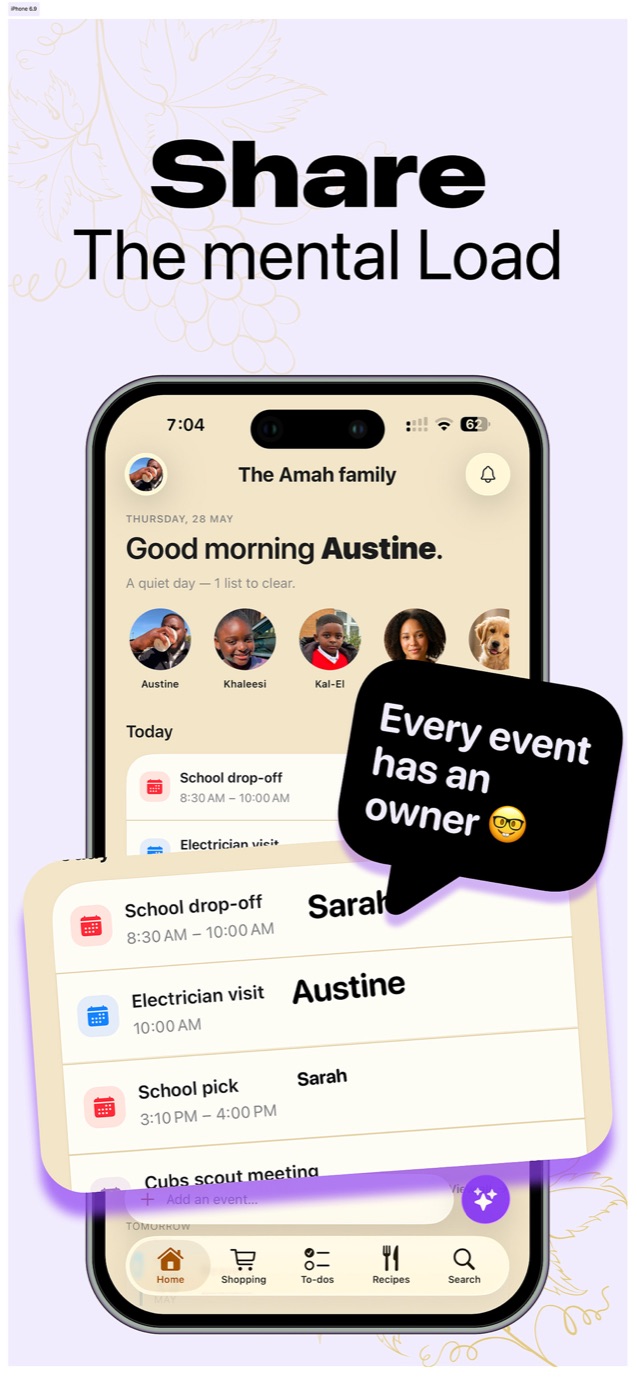
A shared list of chores doesn't change who lies awake running the checklist. What changes it is attaching a name to every item, in a place both of you look at daily. When the calendar says "School pick-up, 3:10, Sarah" there is nothing to negotiate at 2:45 and nothing for anyone else to track.
In Famora every event, todo and shopping run has an owner shown right on it. The home screen reads like a fair-play audit of your week: whose name is on the electrician visit, whose name is on the school run, and how the week balances out between you.
Move from helper to co-manager
Whole categories work better than individual tasks. Instead of splitting Tuesday's dishes, one partner owns groceries end to end: noticing what's low, keeping the list, doing the shop. The other owns, say, kids' activities: the kit, the lifts, the permission slips. Handovers happen at the category level, once, rather than task by task, forever.
Tooling matters here in one specific way: both partners need equal standing. Famora has no "primary parent" role. Both adults are co-managers of the household, with the same power to add, edit and assign. If your current setup makes one person the admin, the mental load has already picked its favorite.
Hold a ten-minute weekly reset
Sunday evening, phones out, ten minutes: walk the week ahead together. Who owns each pick-up, which evenings need cover, what's for dinner Thursday, what needs buying. Assign owners as you go. The meeting is short precisely because the calendar, lists and meal plan are already in one shared place instead of three apps and a fridge door.
Couples who keep this up report the same thing: the arguments don't disappear, they move earlier. Negotiating Thursday on Sunday is a conversation. Negotiating Thursday on Thursday is a fight.
Common questions
- Does a shared calendar alone fix the mental load?
- No. Visibility without ownership just gives both partners a nicer view of the imbalance. The calendar helps once every entry carries a name, because then noticing and remembering transfer along with the task.
- What if my partner refuses to install another app?
- Start alone. Famora works anonymously before sign-up, and you can add your partner as a profile and assign them events you've agreed on verbally. Most reluctant partners join once the week is already organized somewhere visible.