How to make a chore chart for kids that sticks
Chore charts fail from ambition, not laziness. The chart that survives has three chores per child, not eight; a name on every chore, not a rota everyone reinterprets; and a fixed weekly reset. Get those right and the medium barely matters. Get them wrong and the prettiest chart is fridge decoration by week three.
Here's a setup that holds, and where a shared family app helps once paper stops scaling.
Set up a chore chart for kids
- 1
Pick age-appropriate chores
Three per child. A four-year-old feeds the dog and puts toys in the basket; a nine-year-old empties the dishwasher and takes out recycling; a teenager owns their laundry end to end.
- 2
Assign by name, not by rota
"Someone sets the table" means nobody does. Every chore gets one owner, visible to the whole family, swapped only at the weekly reset.
- 3
Schedule the recurrence
Daily chores recur daily, bin night recurs weekly, and odd patterns like every other Saturday are set once. Reminders do the nagging.
- 4
Reset weekly, together
Five minutes on Sunday: check what got done, rotate anything contested, adjust what's not working. The reset is what keeps the chart honest.
Why paper charts die in three weeks
Week one, everyone plays along. Week two, Tuesday's swimming means the table didn't get set, and there's no way to mark an exception, so the chart shows a lie. Week three, nobody updates it and the parent who made it is nagging again, now with props. Paper can't handle exceptions, rotation or being in two places at once, and family life is mostly exceptions.
A chart in a shared app absorbs those hits: skip tonight without deleting the chore, and the chart on every phone stays true.
Ownership by avatar
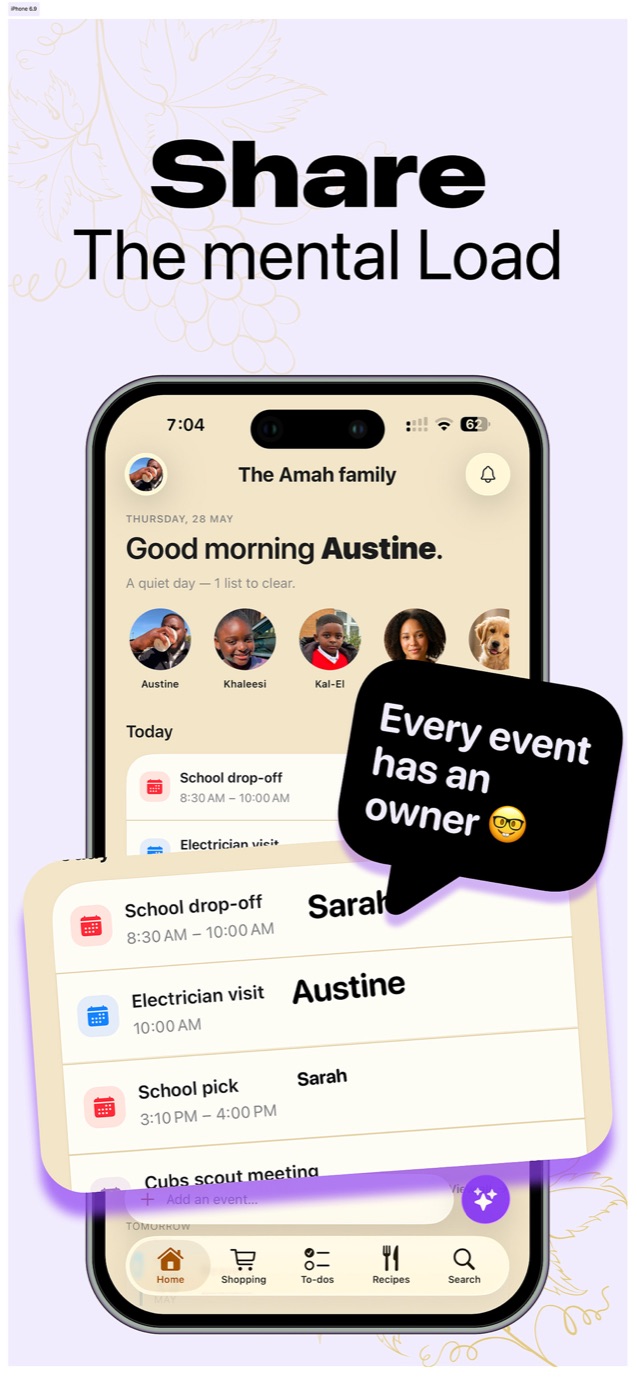
Kids respond to seeing their own name and face on a job. In Famora, chores are todos assigned to a family member's profile, so each child's chores appear under their avatar in their color, right next to the family calendar. No login needed: younger kids check their column on the kitchen iPad or a parent's phone.
Visibility cuts both ways, usefully. Siblings police fairness better than any parent when the columns sit side by side.
Recurrence does the remembering
The parental cost of a chore system is usually the reminding. Move that to software: each chore recurs on its real schedule, the reminder pings the household, and the parent stops being the alarm clock. Advanced patterns matter here too, because real chores run fortnightly, or every other Tuesday, or term-time only.
When a chore genuinely can't happen, cancel that occurrence without touching the series. The chart stays accurate, which is what keeps kids trusting it.
Common questions
- At what age should kids start on the chore chart?
- Around three, with one visible daily job like putting toys in the basket. The habit of "I have a job and I can see it" matters far more at that age than the chore's usefulness.
- Should chores be tied to pocket money?
- Split them. A base set of family-contribution chores is unpaid because everyone contributes; extra jobs beyond the base can earn. Paying for everything teaches negotiation, not contribution.